Oarblade Velocity Vectors
© 2001 Atkinsopht (03/02/09)
The blade fluid attack velocity is the vector sum of the shell velocity
with respect to the water (Vs) and the blade chord-tangential velocity with
respect to the shell (Vb); Figure 1. Vb varies with the oar shaft bow angle
(T) and with the tangential slip under load (Vz): Vb = Vs sinT +Vz. When
there is no load or force (Pt) on the oarhandle Vz is zero; Vb = Vs sinT =
Vb0, and the attack angle is (always) zero--as it is on the zero-slip path.
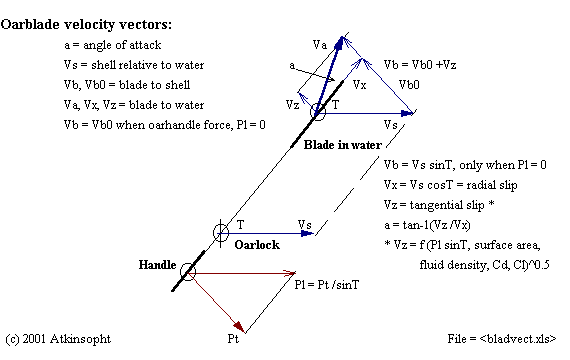 Figure 1
Vz itself is a square root function of Pt, blade surface area, fluid
density, and the lift and drag coefficients of the hydrofoil Cl, and Cd. For
more detail and a discussion of blade velocity and force vectors see
"Oarblade Lift and Drag" Figure
3-5.
Figure 1
Vz itself is a square root function of Pt, blade surface area, fluid
density, and the lift and drag coefficients of the hydrofoil Cl, and Cd. For
more detail and a discussion of blade velocity and force vectors see
"Oarblade Lift and Drag" Figure
3-5.
When the hydrodynamic coefficients for proposed designs become known blade
comparisons may be reliably made using computer models. Measuring Cl and Cd
vs. attack angle for (necessarily rotating) oarblades has now been
done more or less reliably, but
not yet in the rotating condition.
An experiment to determine the lift and drag coefficients of rotating
oarblades was made at MIT in 1993. (see Ramsey,
bibliography ). Ramsey found peak
drag coefficients considerably larger than 2.0 and indications of steep
decline (stall) in lift coefficient at about forty-five degrees.